All species › Swifts › Swifts › Little swift
Little swift | Apus affinis
Huisgierzwaluw | Vencejo moro
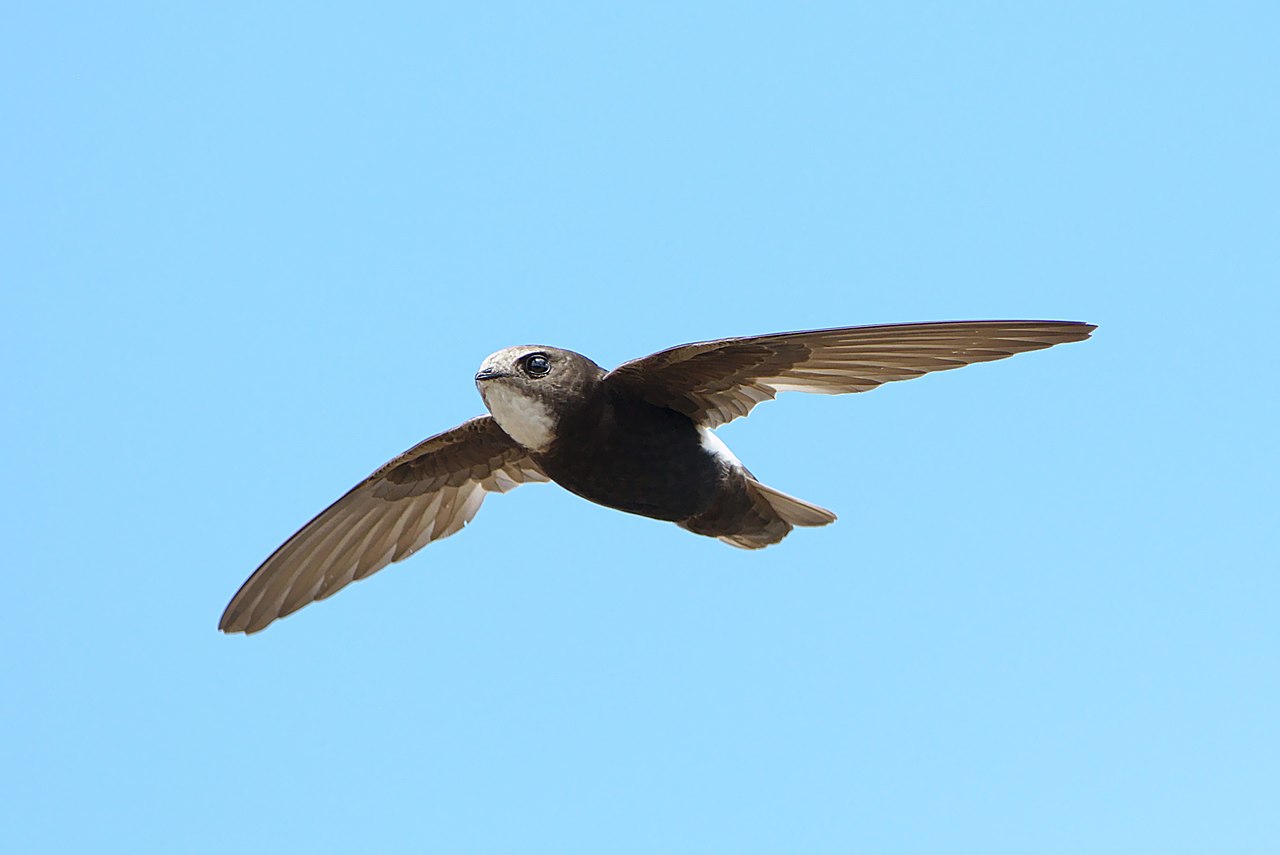
The little swift is the smallest swift in the region, hardly larger than a House Martin, with broad wings and a big square white rump. It nests colonially under bridges, in rock gorges and against buildings. From North Africa it has occupied the southern tip of Spain since 2000.
Voice
Noisy at the colony. The call is a fast, shrill rattling trill, tirrr-tirrr-riririh, given by several birds at once as they circle the nest site. It is higher, drier and more rattling than the drawn-out scream of a common swift. Away from the colony the species is usually silent.
Recording: JMK — CC BY-SA 4.0 · Wikimedia Commons
Identification
Small and stocky, 12 cm long, with a broad-based wing and a blunter tip than a common swift. The tail is square-cut and looks rounded when spread; there is no fork at all. The white rump is large and square and runs well onto the flanks, so the band stays visible from the side and from below at an angle. The throat carries a large, sharply defined white patch that reaches up onto the face. Flight is more fluttering and twisting than a common swift's, with shorter glides and more flickering beats.
Confusion species
Common swift is much bigger (17–18.5 against 12 cm), with stiff scythe-shaped wings, a short forked tail and uniform sooty brown plumage showing at most a pale throat patch; it never has a white rump. Pallid swift is browner, with a stronger head and throat pattern and broader-based wings, and also lacks a white rump. Alpine swift is far bigger and has a white belly, not a white rump. Among the three small white-rumped swifts, little swift is the smallest and stockiest: the rump band is the broadest and squarest and reaches furthest onto the flanks, the white throat is the largest, and this is the only one of the three with a square-cut tail. White-rumped swift is slimmer, with a narrow white crescent that stops short of the flanks and a long, deeply forked tail. Horus swift is intermediate: a broad band that ends on the rear flanks, and a shallowly forked tail.
Habitat
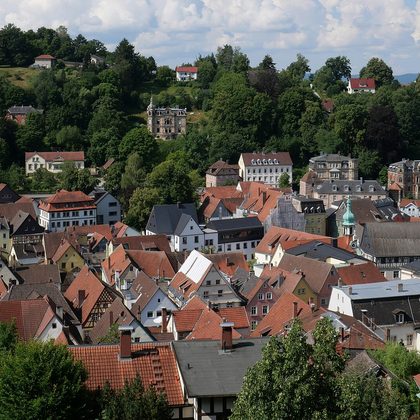
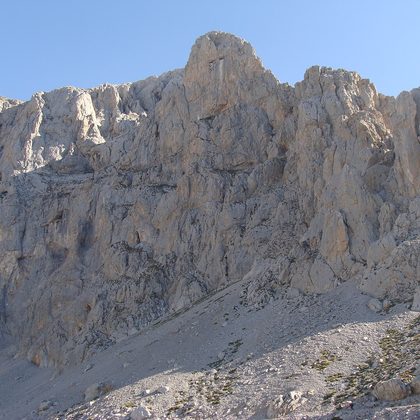
A colonial bird of buildings and rock: nests under bridges and viaducts, in culverts, under eaves and overhanging ledges, and on rock faces in gorges and sea cliffs. Feeds over towns and villages, over reservoirs and rivers and over the surrounding farmland, generally lower than a common swift.
Where the bird is most at home, classified with EUNIS — the European standard for habitats.

Range and movements
Common and largely resident in North Africa — Morocco, Algeria, Tunisia, Libya and the Nile valley in Egypt — and further east in Israel, Jordan and southern Turkey. In Spain it has bred since 2000, when the first confirmed nesting was found in the Sierra de la Plata near Tarifa; a harbour colony at Chipiona followed, still numbering no more than a few dozen birds. In north-western Europe it is a very rare vagrant, with most records in May and the odd bird reaching as far as Britain and the Netherlands.
- Resident
- Breeding (summer)
- Winter
- Passage
- dark = core range, pale = thinly spread
How and when to look
Look for it in southern Spain around bridges and harbour buildings near Tarifa and Chipiona, or in Morocco above the medina and the old town walls, and scan swift flocks for a smaller, stockier shape. On any white-rumped swift let the tail decide first: square-cut means little swift.
Conservation status
Not globally threatened (IUCN: Least Concern) and increasing in many areas, because bridges, viaducts and buildings supply extra nest sites. There are local losses: in Turkey one regional population halved after reservoirs flooded its breeding sites. In Spain the colonisation is still young and the numbers small, so disturbance at a single colony carries real weight.
Scientific name
Apus affinis | (Gray, 1830)
Gray described the species in 1830 as Cypselus affinis; because it was later moved to another genus, the author and year stand in brackets. The genus Apus was introduced in 1777 by Scopoli. Apus is Latin for a swift, from Greek a- 'without' and pous 'foot', the ancients taking it for a kind of swallow without feet. affinis is Latin for 'related to, similar'; which species the bird supposedly resembles is not clear from the description. The specimen the first description was based on came from the Ganges, India.