All species › Cranes, rails and allies › Rails and crakes › Water rail
Water rail | Rallus aquaticus
Waterral | Rascón europeo
The most heard and least seen marsh bird in north-west Europe. From any dense reedbed a burst of squealing, pig-like screams can suddenly break out while the bird itself slips unseen between the stems.

Click a thumbnail to switch the photo above.
Voice
The famous sharming: a burst of grunting notes running into shrill wailing squeals, exactly like a piglet being seized, krrooee-krrooee-krooo-eee, slowly dying away. There is also a rhythmic pumping kipp kipp kipp used as territorial song in spring. Heard mainly at dusk and through the night, all year including midwinter; a slammed car door often triggers an instant answer.
Recording: Franz Lindinger — CC BY-SA 4.0 · Wikimedia Commons
Identification
Slim, laterally flattened body, olive-brown with black streaks above and slate-blue on face, neck and breast. The flanks are barred black and white, the undertail is creamy and flicked up as it walks. Decisive is the long, slightly down-curved, orange-red bill. Often all you see is that bill and a piece of grey breast between the reeds.
Confusion species
Every other crake has a short bill; the long red bill is unique and settles any record. Spotted crake is smaller, browner and white-spotted. A juvenile water rail is browner on the breast with a pale throat and can suggest spotted crake, but always has the long bill and unspotted underparts.
Habitat
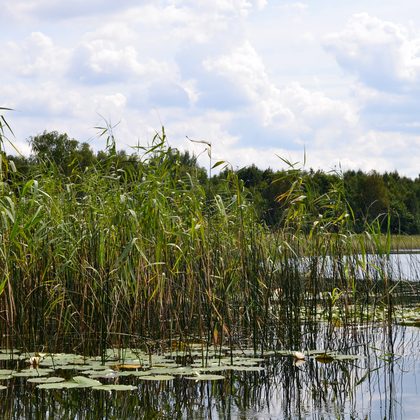
Dense, permanently wet reedbed, sedge marsh, silting ditches with reed sweet-grass, flooded alder carr and overgrown pond margins. It needs shallow water with heavy cover and soft mud to feed in. In hard winters birds move to springs, flowing ditches and even town parks, where they suddenly become visible in the open.
Where the bird is most at home, classified with EUNIS — the European standard for habitats.


Range and movements
Breeds across nearly all of Europe, from Ireland to the Urals, partly resident and partly migratory. In the Netherlands it is a common but under-recorded breeder of all larger marshes, joined in winter by birds from the north-east. In Spain it breeds scattered in fresh and brackish marshes, and the south holds substantial numbers of European birds in winter.
- Resident
- Breeding (summer)
- Winter
- Passage
- dark = core range, pale = thinly spread
How and when to look
Go to a reed marsh at dusk in March or April and wait on a track beside open water. Winter is surprisingly the best time to see one: in frost they walk in full view at open patches and under footbridges. Otherwise sit still at a muddy reed edge and let the bird come out by itself.
Conservation status
Common nationally and not threatened, though hard winters kill locally. Drying out, mowing and flailing of reed fringes, rigid water levels and the conversion of marsh to commercial reed all reduce habitat quality. Large new wetlands with natural level dynamics, by contrast, deliver high densities almost at once.
Scientific name
Rallus aquaticus | Linnaeus, 1758
Linnaeus described the species in 1758 and placed it straight away in the genus where it still stands. He introduced the genus Rallus in that same work. Rallus is the name English ornithologists such as Willughby and Albin already used for the water rail before Linnaeus; the precise origin of the word is uncertain. aquaticus is Latin for 'living in water', from aqua 'water'. The specimen the first description was based on came from Great Britain.