All species › Passerines › Tyrant flycatchers and allies › Sulphur-bellied Flycatcher
Sulphur-bellied Flycatcher | Myiodynastes luteiventris
Witvoorhoofdtiran | Bienteveo Ventriazufrado
The Sulphur-bellied Flycatcher is the only heavily streaked flycatcher that breeds in the United States, in the sycamore canyons of southeastern Arizona. It arrives later than almost any other summer bird and is gone again in September, bound for the eastern foot of the Andes.
Voice
The call is a high, squeaky two-syllable note recalling an unoiled wagon wheel or a squeeze toy; pairs often call in a loud duet, which carries far. There are also ticking, drumming notes and a softer song from the male. For a species that stays hidden in dense canopy, that sound is the first and usually the only sign of its presence.
No freely licensed recording has been found for this species yet; what to listen for is described below.
Identification
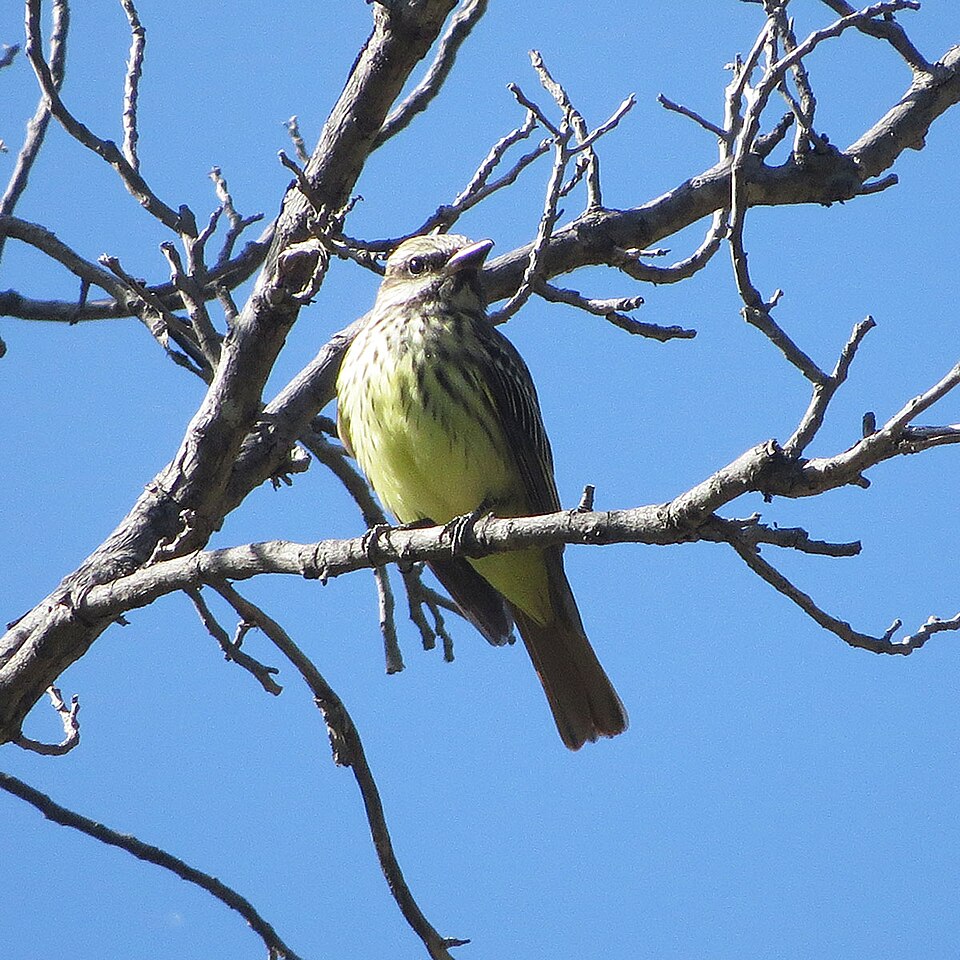
Upperparts olive-brown with dark streaks; the underparts are pale sulphur-yellow with broad, coarse black streaks across the breast and finer streaks on sides and flanks. The head is striped: a whitish forecrown, a dark mask through the eye and a dark malar stripe beside the white throat. A concealed canary-yellow patch lies among the crown feathers. Characteristic is the cinnamon-rufous tail with dark feather shafts, which shows as a warm stripe the moment the bird flies off. The bill is heavy and dark.
Confusion species
Within the guide area the combination of coarse breast streaks and rufous tail is unique. Further south it overlaps with Streaked Flycatcher, its sister species: that bird has a pale bill base, finer and less contrasting breast streaks and a less uniformly rufous tail, and gives a hoarse, low series instead of the high squeal. Variegated Flycatcher, a rare vagrant, is smaller, with a black crown and white eyebrow, much finer streaking and a dark tail with a narrow rufous edge. Great Kiskadee is plain yellow and brown, without streaks.
Habitat
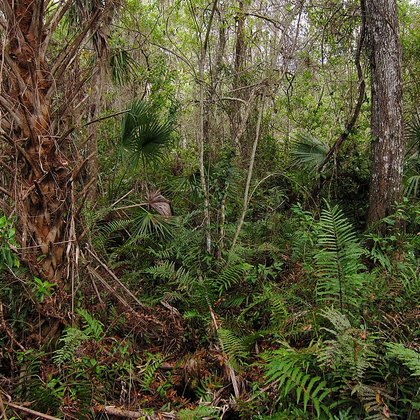
In the north of the range it is confined to streamside canyon floors with tall Arizona sycamore, walnut and maple, mostly between 1200 and 1800 metres in the Madrean sky islands. It nests in large natural cavities, chiefly in sycamores, 6 to 15 metres up, and takes over nest holes from Dusky-capped Flycatchers and Northern Flickers, even when a nest with eggs is already in place. Further south it uses deciduous and gallery forest in the tropical and subtropical zone; on the wintering grounds, riverside forest and second growth.
Where the bird is most often found, arranged by the USNVC — the vegetation classification of the United States and Canada — and CMECS for sea and coast.




Range and movements
A long-distance migrant. The breeding range runs from southeastern Arizona and extreme southwestern New Mexico south through the Sierra Madre Occidental, and along eastern Mexico across the Yucatán Peninsula and Central America to Costa Rica. In Arizona the birds arrive in late May or early June and leave in September. The winter is spent on the eastern Andean slope, from northern Ecuador through Peru to northern Bolivia — outside the area of this guide.
- Breeding (summer)
- Winter
- Passage
- dark = core range, pale = thinly spread
Where and when to look
June to early August in Cave Creek Canyon, Madera Canyon or Ramsey Canyon gives the best chance. Find it by ear rather than by eye: it usually sits still and high in the closed sycamore canopy, and the squeaky duet of a pair gives the place away. When it flies, the rufous tail is the mark that stays with you.
Conservation
The IUCN lists the species as Least Concern, with a stable population of more than two million mature birds. In the United States numbers are stable or slightly rising, but the breeding range is small and wholly dependent on riparian canyons with old sycamores. Loss of groundwater and of cavity trees in those canyons affects the species directly, since it cannot excavate a hole itself.
Scientific name
Myiodynastes luteiventris | Sclater, 1859
Philip Lutley Sclater described the species in 1859 under the name it still carries, so author and year stand without parentheses. The genus Myiodynastes comes from Greek muia 'fly' and dunastes 'ruler'. The species name luteiventris is Latin: luteus 'yellow' and venter 'belly', so 'yellow-bellied'. The type was later fixed on Orizaba in Veracruz, Mexico. The Dutch name refers to the pale forecrown, the English and Spanish names to the yellow belly.