All species › Passerines › Cardinals and allies › Yellow Grosbeak
Yellow Grosbeak | Pheucticus chrysopeplus
Gele kardinaal | Picogrueso amarillo
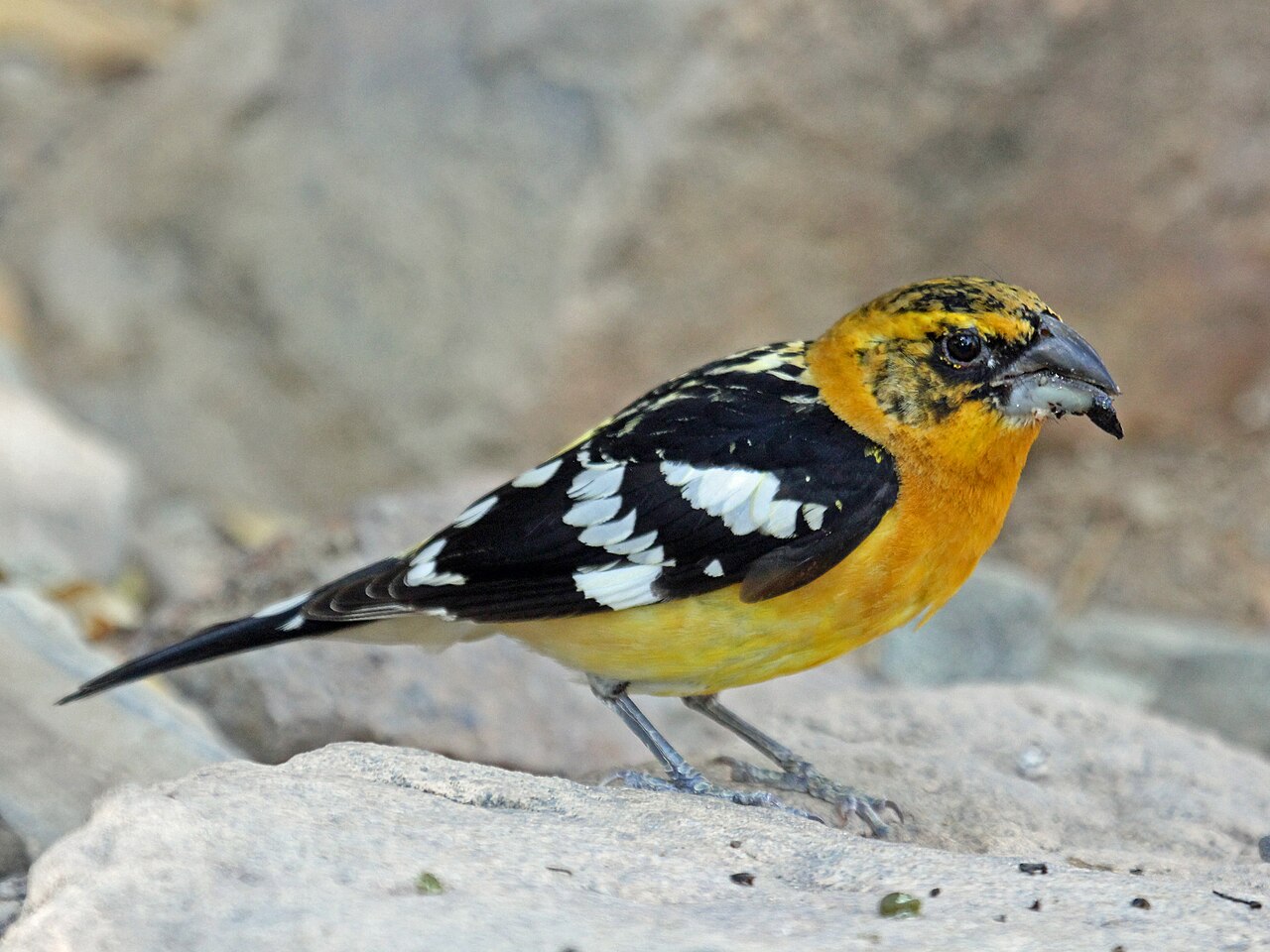
The Yellow Grosbeak is the largest of the four Pheucticus species and the only one with a wholly yellow head and underparts. It belongs to the Pacific slope of Mexico, from Sonora to Oaxaca, and reaches Arizona only as a summer vagrant.
Voice
The call is a metallic, short iehk or plihk, harder and sharper than that of Black-headed Grosbeak, with a softer thin note given in flight. The song is a flowing, robin-like warble, but shorter and with fewer changes than the song of Black-headed or Rose-breasted Grosbeak; the male sings from a high branch at the forest edge, mostly early in the morning during the rainy season.
No freely licensed recording has been found for this species yet; what to listen for is described below.
Identification
The male has an unmarked yellow head, breast and belly, a black back mottled with yellow, a yellow rump and black wings and tail with large white marks. The bill is heavy and conical, with a pale lower mandible. The female is duller: olive-yellow rather than golden, grey where the male is black, and with smaller white wing marks. Young birds resemble the female but have browner wings. At 21.5 to 24 cm the species is noticeably larger and heavier than the other North American grosbeaks.
Confusion species
Black-headed Grosbeak has a black head, an orange-brown breast and a yellow belly, and is smaller; only very pale females of that species can cause doubt in poor light, but their underparts are buff with streaking on the flanks, not plain yellow. A female-type Yellow Grosbeak still stands out by its heavy bill, its size and its unstreaked yellow underparts. For a yellow grosbeak in Arizona an escaped cage bird is a real possibility; check feather wear and leg rings.
Habitat
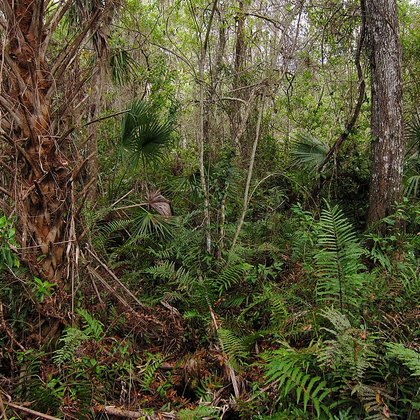
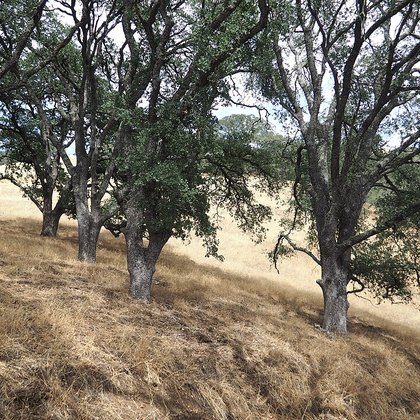
Tropical deciduous forest, thorn forest and pine-oak woodland in hill country, generally below 1800 metres. It stays high in the trees, at forest edges and in semi-open growth along streams and fields, and avoids both closed rainforest and cloud forest. In the dry season small groups gather at fruiting trees.
Where the bird is most often found, arranged by the USNVC — the vegetation classification of the United States and Canada — and CMECS for sea and coast.




Range and movements
The range lies almost entirely on the Pacific slope of Mexico, from central Sonora and southwestern Chihuahua south through Sinaloa, Nayarit, Jalisco and Guerrero to northwestern Oaxaca, with a separate population in southern Chiapas and Guatemala. In the north, in Sonora, the species is migratory and present only in summer; farther south it stays year-round. In the United States a few dozen records have been established, mostly in southeastern Arizona and usually from May to July, with scattered records from California, New Mexico, Colorado and Iowa.
- Resident
- Breeding (summer)
- Winter
- Passage
- dark = core range, pale = thinly spread
Where and when to look
In western Mexico the best chance is early in the morning along a stream in deciduous forest, where the bird sits high in a flowering or fruiting tree. In Arizona it almost always concerns a single bird at a feeding station in the border canyons, from May to July; such records are usually reported quickly.
Conservation
The IUCN places the species in the least concern category: the range is large and the population is judged stable. The tropical deciduous forest of the Pacific slope is declining through conversion to pasture and cropland, which causes local disappearance. The species is also kept as a cage bird in Mexico; the scale of trapping has not been established.
Scientific name
Pheucticus chrysopeplus | (Vigors, 1832)
Vigors described the species in 1832 as Coccothraustes chrysopeplus from material from Mexico, later restricted to San Blas in Nayarit; because of the move to another genus, author and year stand in parentheses. The genus Pheucticus goes back to Greek pheuktikos 'shy, inclined to avoid'. The species name chrysopeplus comes from khrusos 'gold' and peplos 'robe', and thus means 'with the golden robe'.